
What Risk Factors Can Change the Safety Profile of Melanotan II Side Effects
Four things move the risk picture most: a personal or family history of melanoma, a high mole count, concurrent tanning bed use, and cardiovascular vulnerability. Melanotan II activates melanocytes systemically, so whoever already carries the highest melanoma baseline has the most to lose. Men carry an additional documented risk of priapism.
Why the same exposure lands differently
Nothing about this compound produces one uniform outcome. It is an alpha-melanocyte-stimulating hormone analogue acting at the melanocortin 1 receptor, and its pigmentary effect lands on whatever melanocytic material a person already has. Someone with fifteen moles and someone with two hundred receive the same signal against very different backgrounds. That is why the published record reads as it does: the serious dermatological cases tend to involve people already at elevated melanoma risk.
Existing melanocytic burden and family history
This is the risk factor with the clearest supporting cases. A report in Dermatology Practical and Conceptual described a teenager with familial atypical multiple mole melanoma syndrome whose melanocytic lesions changed following melanotan injections combined with sun bed use. A 2026 report in JAAD Case Reports described five primary melanomas in situ in a patient whose recent history combined tanning bed use, melanotan exposure, and anabolic hormone use.
A 2017 review in the International Journal of Dermatology identified four published case reports of melanoma emerging from existing moles during or shortly after melanotan use, while stating that conclusive evidence linking the two is not available. None establishes causation. Collectively they suggest that people with a high nevus count, atypical mole syndrome, or a family history are the group in whom an agent that darkens and multiplies nevi is least advisable.
Concurrent ultraviolet exposure
The exposures travel together. In a study of UK and Ireland online forums covering 623 entries from 205 participants, sunbed use appeared as a recurring theme alongside melanotan injection, with users treating the two as complementary. Several of the more serious published cases involve both. UV exposure is an established melanoma risk factor in its own right, and the drug does nothing to offset it.
Any assumption that induced pigmentation substitutes for sun protection lacks support. The tanning literature is consistent that the risks of deliberate UV exposure outweigh claimed benefits.
Cardiovascular and neurological vulnerability
The systemic events reported for this compound are pressure and catecholamine events. The 2012 Clinical Toxicology case described a man arriving two hours after injection with tachycardia peaking at 146, elevated blood pressure, sweating, mydriasis, and tremor, progressing to rhabdomyolysis with creatine kinase at 17,773 IU/L and impaired kidney function.
Posterior reversible encephalopathy syndrome, reported in Annals of Internal Medicine and named on the FDA’s summary of this substance, is typically associated with acute blood pressure elevation. Renal infarction was described in a 2020 CEN Case Reports paper. Existing hypertension, arrhythmia, coronary disease, or reduced kidney reserve all shrink the margin when a sympathomimetic episode occurs.
Sex, and predisposition to priapism
Erection is a primary pharmacological action of this molecule, not an incidental effect. It was the endpoint of the original human studies, where erections developed in eight of ten men in one crossover trial. Priapism is the same effect failing to switch off, and it is documented in published case reports. Anyone predisposed to priapism, including sickle cell disease, or already taking medication acting on erectile function, is combining mechanisms with no data on the interaction. The emergency threshold remains four hours regardless of trigger.
How the risk factors stack
| Risk factor | Mechanism | What it changes | Evidence class |
|---|---|---|---|
| High nevus count or atypical mole syndrome | More melanocytic targets | Raises the surveillance burden sharply | Case reports, melanoma risk data |
| Family or personal melanoma history | Elevated baseline risk | Makes obscured lesion change consequential | Case reports, risk data |
| Concurrent sunbed or sun exposure | Independent carcinogen | Stacks with the pigmentary effect | Forum research, case histories |
| Hypertension or cardiac disease | Sympathomimetic events | Shrinks margin in an acute reaction | One detailed toxicology case |
| Reduced kidney reserve | Rhabdomyolysis, infarction | Worsens a systemic event | Two case reports |
| Male sex | Erection is a primary action | Introduces priapism risk | Trials, case reports |
| Shared injection equipment | Bloodborne and local infection | Risk unrelated to pharmacology | Forum research, systematic review |
| Unknown vial content | No identity or sterility assurance | Makes every other factor unpredictable | Analysis of purchased product |
Injection practice is its own risk factor
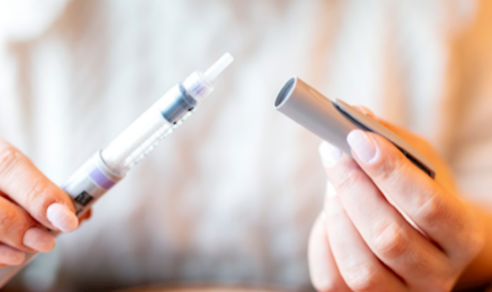
A systematic review of injecting use of image and performance enhancing drugs placed this behavior in a wider pattern, and forum research on melanotan named transmission of infectious disease, contaminated product, and combined use with other substances as hazards. That is not pharmacology. It follows from preparing and injecting a powder outside any controlled setting.
The material compounds it. Chemists who purchased vials from three online shops found all sold as 10 mg while containing between 4.32 mg and 8.84 mg, with unknown impurities at 4.1 to 5.9 percent in two of the three. The FDA has flagged immunogenicity risk for certain routes due to potential aggregation or peptide-related impurities. Even afamelanotide, the one approved agonist at this receptor, carries a postmarketing warning for serious hypersensitivity reactions including anaphylaxis.
The risk factor nobody can modify
The largest variable is that there is no legitimate route to this substance at all. Melanotan II has no approved US product, no current DailyMed label, and no lawful compounding pathway, since its bulk substance nomination was withdrawn and the FDA published the safety risks it had identified instead. Every dose is unsupervised by definition, and the risk factors above are managed by the person injecting rather than anyone with training.
That is the contrast worth drawing, because the supervised model does exist for compounded medicine generally. When a preparation has a lawful route, a licensed clinician screens the history, a registered pharmacy prepares the vial, and there is a record. Cash-pay telehealth operations including Marek Health, Invigor Medical, and this physician-supervised provider run on that structure. Melanotan II is excluded from it entirely, so none of the screening that would normally catch a family melanoma history or uncontrolled hypertension ever happens.
Anyone who has used it and carries any of the risk factors above, particularly a family history or a mole that has changed, should get a dermatology appointment and state the exposure plainly.
Risk screening plays out differently wherever an approved drug exists. In GLP-1 weight management, an intake actually captures cardiovascular and family history before anything is prescribed, and providers such as Ro, Henry Meds, and HealthRX post open guidance on GLP-1 side effects, with LillyDirect connecting patients to branded manufacturer supply. Melanotan II skips every one of those checks, so the risk factors that matter most are the ones nobody screened for.
Frequently asked questions
Does a low mole count make this safe?
It lowers one risk without addressing the others. Someone with few moles still faces the systemic effects, the priapism risk if male, and the separate hazards of unknown vial content and non-sterile injection. Fewer melanocytic targets narrows the dermatological problem rather than removing the concern.
Is skin type a meaningful factor?
Fair skin carries a higher baseline melanoma risk regardless of what is injected, and it is also the group most drawn to a tanning shortcut. That combination is the concerning part. Published cases do not support any claim that darker skin types are exempt from the nevus changes described.
Do women avoid the serious effects?
Only priapism, which is anatomically specific. The dermatological case reports include women, and nausea, flushing, and appetite change are not sex-specific either. Infection risk from injection practice and the uncertainty around what a vial actually contains apply to everyone regardless of sex.
Can a clinician screen someone before use?
There is no lawful supply to screen for, so the question does not arise in practice. What a clinician can do is assess someone who has already used it, establish their melanoma risk category, examine the skin, and set a follow-up interval.