10 Mind-Blowing Innovations in Electrical Design You Didn’t Know Existed
The landscape of modern technology is often defined by what we can see: sleek smartphones, shimmering skyscraper facades, and autonomous vehicles. However, the true revolution is happening beneath the surface, within the invisible architecture of electrical design. In the United States, where the push for a “Smart Grid” and renewable energy integration is reaching a fever pitch, electrical engineering is no longer just about moving electrons from point A to point B. It is about intelligence, efficiency, and material science breakthroughs that were once relegated to science fiction.
For many students and aspiring professionals entering this field in American universities, the sheer complexity of these advancements can be overwhelming. From quantum-level semiconductors to grid-scale wireless power, the curriculum is expanding faster than many can keep up with. It is quite common for those feeling the pressure of these high-stakes courses to seek professional electrical engineering assignment help. Understanding the math behind Wide Bandgap semiconductors or the physics of piezoelectricity requires more than just a textbook; it requires a strategic approach to technical mastery.
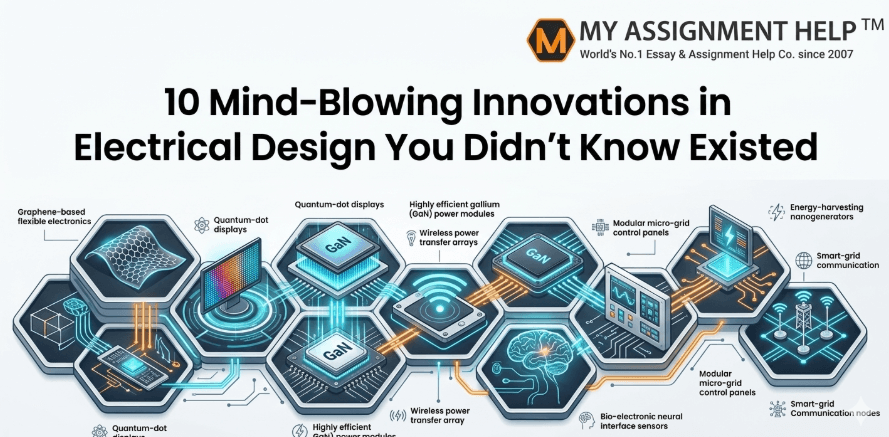
As the industry evolves, the demand for high-level expertise grows. Whether you are a homeowner curious about the future of energy or a student looking for someone to do my assignment to balance the heavy workload of an engineering degree, staying informed about these innovations is crucial. Here are 10 mind-blowing innovations in electrical design currently reshaping our world.
1. Gallium Nitride (GaN) Semiconductors
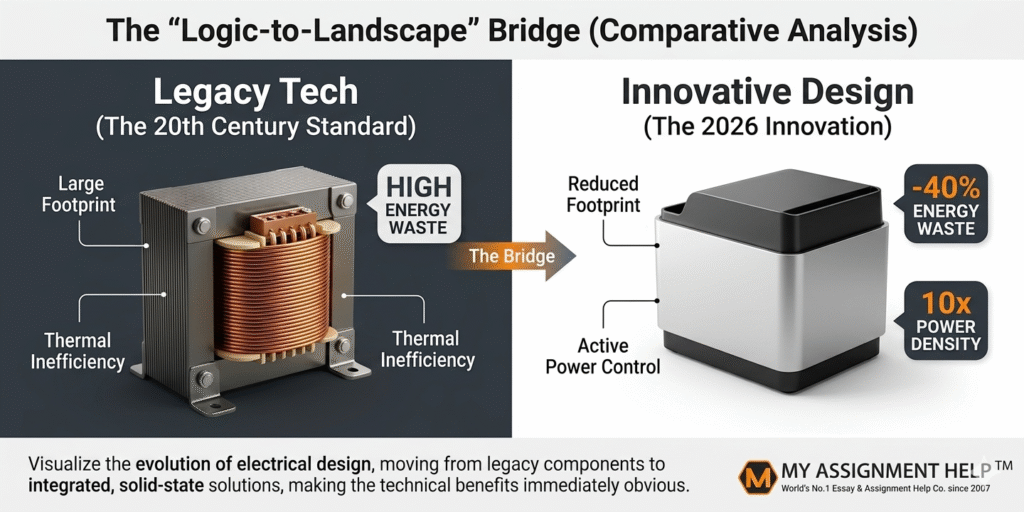
For decades, Silicon has been the king of the semiconductor world, but it has a speed limit. Gallium Nitride (GaN) is a “Wide Bandgap” material that allows components to operate at much higher voltages and frequencies. In the US, GaN is why new laptop chargers are half the size of old ones but twice as fast, reducing energy loss by up to 40%.
2. Solid-State Transformers (SST)
Traditional transformers are heavy, oil-filled, and “dumb”. Solid-State Transformers use advanced power electronics to manage power flow bidirectionally. This is essential for the US grid, allowing for the seamless integration of residential solar panels and EV charging stations without crashing local voltage levels.
3. Wireless Power Transfer (WPT) at Industrial Scale
Researchers at US institutions like Stanford are developing “Dynamic Wireless Charging”. Imagine an electric highway where copper coils embedded in the asphalt charge your car while you drive at 65 mph. This technology uses magnetic resonance to transfer power across an air gap with over 90% efficiency.
4. Liquid Wire and Stretchable Circuits
Electrical design is becoming “soft”. By using liquid metal alloys encased in elastic polymers, engineers have created circuits that can stretch to three times their length without losing conductivity. This is a game-changer for the US medical device industry, enabling wearable heart monitors that feel like a second skin.
5. Diamond-Based Power Electronics
Synthetic diamond semiconductors can handle heat levels that would melt traditional components. This makes them perfect for the extreme environments of US aerospace and deep-sea exploration, where cooling systems are often too heavy or impractical to install.
Data Insights: Efficiency Gains in US Electrical Design
| Technology | Standard Performance | Innovative Performance | US Economic Impact (Est. 2030) |
| Power Conversion | 88% (Silicon) | 98% (GaN/SiC) | $15B Energy Savings |
| Transmission | 7% Loss (Copper) | <1% Loss (Superconductors) | Grid Stability +40% |
| EV Charging | 4-8 Hours (Level 2) | 15 Mins (Wireless Resonant) | Accelerated EV Adoption |
Source: Compiled from DOE and IEEE Industry Reports 2025.
6. Smart Dust (MEMS)
Micro-Electro-Mechanical Systems (MEMS), or “Smart Dust,” are microscopic sensors that can be sprayed onto infrastructure. In the US, these are used to prevent wildfires by detecting “arcing” in high-voltage lines before a spark ever touches the ground.
7. Transparent Solar Cells (Photovoltaic Glass)
US startups are producing transparent photovoltaic coatings that turn skyscraper windows into solar panels. These coatings absorb UV and infrared light while letting visible light through, turning glass buildings in cities like New York into vertical power plants.
8. High-Temperature Superconductors (HTS)
HTS materials move electricity with zero resistance at “warmer” (though still very cold) temperatures. Using these for US urban power grids allows for the transmission of 10x more power through the same underground space.
9. Piezoelectric Kinetic Flooring
Piezoelectric materials generate electricity when squeezed. US airports and stadiums are beginning to install “kinetic tiles” that harvest energy from footsteps; a single step can power an LED light for 20 seconds.
10. Bio-Batteries (Microbial Fuel Cells)
Microbial fuel cells use bacteria to break down organic waste and release electrons. US agricultural tech companies are exploring this to turn farm wastewater into electricity for remote sensors and irrigation systems.
Key Takeaways
- Material Science is Key: The future of electrical design lies in GaN, SiC, and synthetic diamonds.
- Efficiency over Capacity: Saving 1% of energy at grid scale is often more valuable than building a new power plant.
- Decentralization: Technologies like kinetic flooring and transparent solar move us toward a “Distributed Energy Resource” model.
- Academic Rigor: Mastering these concepts requires advanced support as US standards (NEC) evolve.
See also: Transform Your Home with Modern Pitched Roof Daylighting Ideas
FAQ Section
Q: Are these technologies currently in use in the USA?
A: Yes, many are in pilot phases. GaN is already in consumer electronics, and HTS cables are being tested in several major US cities.
Q: How do these innovations affect electrical engineering students?
A: The curriculum is becoming multidisciplinary, requiring knowledge of chemistry, physics, and advanced software modeling.
Q: Can I get help with my electrical engineering homework on these topics?
A: Absolutely. Specialized academic services provide expert guidance on everything from circuit design to advanced power systems analysis.
Author Bio: Dr. Robert Miller
Dr. Robert Miller is a Senior Content Strategist at MyAssignmentHelp with over 15 years of experience in the electrical engineering sector. He formerly worked as a systems consultant for US power utilities and now focuses on helping students navigate the complexities of modern engineering curricula through authoritative, data-driven content.
Sources and References:
- U.S. Department of Energy (DOE) – “State of the Grid Report 2025”.
- IEEE Power and Energy Magazine – “The Rise of Wide Bandgap Semiconductors”.
- National Institute of Standards and Technology (NIST) – “Smart Grid Interoperability Standards”.
- Stanford University Engineering – “Dynamic Wireless Power Transfer Research”