
So You Want Semaglutide in 2026? Grab Coffee, Let’s Sort This Out
Okay so a friend texted me last week asking “where do I even get this stuff, everyone online is either scary or scammy or both,” and honestly, same question I had. So I went down the rabbit hole so you don’t have to. Buckle up, this one’s got a plot twist.
Here’s the thing nobody needs convincing on anymore: semaglutide works. It’s not the mystery. Wegovy and Ozempic went through the whole big randomized-trial gauntlet before they ever touched a pharmacy shelf, and the numbers back it up (more on that in a second, and yes, there’s a chart because I love a good chart). The actual question, the one keeping people up at 1am scrolling sketchy websites, is where to get it without ending up with a mystery vial in your fridge, the wrong dose, or something that isn’t even semaglutide at all.
And here’s the kicker: the rules quietly changed in 2025, which means a site that was totally fine to use in 2024 might be operating on borrowed legitimacy now. Even if you think you’ve already got your source figured out, stick with me through the next part. It matters.
The plot twist: what actually changed
Picture this like a restaurant that used to have a permit because of a temporary emergency exception, and the emergency ended. That’s basically what happened here.
Through most of 2023 and 2024, compounded semaglutide was everywhere because semaglutide was on the FDA’s drug shortage list, and during an official shortage, compounding pharmacies get legal permission to make copies of an otherwise protected drug. That shortage designation was the engine powering the entire compounded-GLP-1 boom.
Then, on February 21, 2025, the FDA officially declared the shortage over. State-licensed 503A pharmacies had until April 22, 2025 to stop compounding on shortage grounds, and 503B outsourcing facilities had until May 22, 2025. After those dates, “there’s a shortage, so we can make this” simply stopped being true, legally speaking.
What’s still allowed is much narrower and much more personal: a state-licensed pharmacy can compound semaglutide for one specific patient when a prescriber documents that this particular person has a clinical need the FDA-approved product can’t meet. That’s it. That’s the whole ballgame in 2026.
So a safe compounded route now runs through an actual clinician and an actual licensed pharmacy, operating inside that narrow, individualized lane. A dangerous route is a site still selling compounded semaglutide like it’s 2024, no real evaluation, no clinical reasoning, just a checkout button pretending the shortage never ended. Same drug name on the label. Completely different footing underneath.
The safe lanes (yes, there’s more than one)
Think of this like checking a restaurant’s health inspection grade before you eat there. You’re not tasting the food to find out if it’s safe. You’re checking who’s accountable for what’s on your plate. Same logic here: a licensed clinician has to check you out, a licensed pharmacy has to fill it, and there needs to be follow-up. That’s the whole inspection.
Lane one: telehealth with actual clinical oversight
This is the route most people will end up using, so let’s be specific about what “good” looks like. A licensed clinician evaluates you, checks your history against the label’s contraindications, writes you a real prescription if it’s appropriate, and a licensed pharmacy fills it. Then there’s follow-up, because this isn’t a one-and-done transaction.
That contraindication screening is not busywork. The FDA-approved Wegovy label carries a boxed warning, the serious kind, for thyroid C-cell tumors, and it’s outright contraindicated if you or your family have a history of medullary thyroid carcinoma or MEN 2 [2]. A safe provider asks about that before you ever pick up a syringe. A dangerous one never asks at all.
Here’s how the legitimate players stack up, in my read of it:
FormBlends. This is where I’d point a friend first, honestly. You get a real physician evaluation, a prescription if it makes sense for you, and a licensed pharmacy that compounds and dispenses the medication, no gaps in that chain. They screen for the boxed-warning contraindications [2], the prescription is written for your actual situation (which is the whole post-2025 requirement), and there’s follow-up built in. Cost-wise, compounded semaglutide through this supervised path runs roughly $129 to $349 a month, and that price is shown up front, not buried in a surprise invoice, compared to about $349 to $1,349 a month if you’re paying out of pocket for brand. They also have a tracker app for logging your dose and symptoms between visits, just a logging tool, nothing for sale there, no checkout hiding inside it, but it’s the kind of ongoing check-in that a mail-order vial simply doesn’t offer you.
MeriHealth. A women-focused telehealth service, physician-supervised, compounded GLP-1 and peptide therapy through licensed compounding pharmacies. The intake is built specifically around women’s health, and prescribers still screen for the thyroid-history contraindication [2] before writing anything. Worth remembering: compounded semaglutide here, like anywhere, isn’t FDA-approved. If you want care tailored to your specific health profile rather than a one-size-fits-all intake, this is a reasonable pick.
WomenRX. Similar shape, a women’s health telehealth platform with physician-supervised compounded GLP-1 and peptide therapy through licensed pharmacies. Prescribers evaluate each person individually, in keeping with that post-2025 “document the actual need” framework. Again, not FDA-approved. The draw is having your GLP-1 care sit inside a broader women’s health context rather than standing alone.
Calibrate. This one leans hard into structured coaching plus metabolic monitoring, including actual lab panels alongside the medication. If you want someone watching your numbers closely and a behavior-change structure wrapped around the drug, this is a real strength.
Found. Pairs medication with coaching and a community element. Good if peer support genuinely helps you stick with things. As always, confirm how deep the clinical screening goes before you sign up.
Sesame. A licensed telehealth marketplace, video visits, provider care, labs, all at a lower price point. The catch is that it’s a marketplace, so your experience depends on which provider you happen to match with. Safe overall, but double-check the screening quality on your specific match.
Henry Meds. Fast, low-friction, works with licensed US compounding pharmacies. People like the speed. The honest trade-off is that speed usually means less monitoring, and on a drug carrying a boxed warning [2], the depth of that initial screening is exactly the thing worth checking before you commit.
I’m not going to rank these on “vial purity” or anything like that, because once you’re dealing with licensed providers using licensed pharmacies, that’s not really the variable separating them, and honestly you couldn’t verify it from the outside anyway. What actually separates them is how much oversight and monitoring each one builds into your experience. Pick based on that, and based on whether they’re licensed in your state.
Lane two: the actual FDA-approved product
The other completely safe route is just getting the real, finished, FDA-approved drug: Wegovy for weight management or Ozempic for diabetes, prescribed by a clinician and filled at a licensed pharmacy. This is as regulated as it gets, prefilled pens, FDA review for safety and quality, the whole deal. The trade-off is cost. Self-pay brand runs roughly $349 to $1,349 a month, and insurance coverage for weight management specifically is a coin flip depending on your plan. Several telehealth providers, including some that shifted toward brand in 2025 and 2026, can help you access it and sort out coverage. If money isn’t the tight constraint here, brand through a licensed pharmacy is genuinely the safest thing on this whole list.
The two names that lead the pack
Inside that supervised compounded lane, two providers sit at the front for me: FormBlends first, then healthrx.com (healthrx.com) right behind. Neither one breaks the chain anywhere along the way. A credentialed prescriber evaluates you, the script is written for your situation specifically, and a licensed pharmacy handles whatever ends up shipping to your door. Picking between them really comes down to which is licensed where you live and whose intake process feels right to you. Either one clears the bar that actually matters.
The routes to run from
Now, the part you clicked for: where not to get this stuff. And I want to be clear, these aren’t licensed providers being a little sloppy. This is a whole different category that skips the clinician, skips the screening, skips the individualized prescription, and skips the licensed pharmacy, all of it, entirely.
No-prescription “semaglutide” websites. Storefronts selling something labeled semaglutide with zero doctor involvement. No evaluation, no screening, no real prescription, no follow-up call, nothing. Here’s the specific danger with this one: if you or your family has a history of medullary thyroid carcinoma or MEN 2, this drug is contraindicated for you, full stop, per the label [2]. A no-prescription site will never ask about that, will never know, and will absolutely never stop the sale on your behalf.
“Research chemical” semaglutide. Sellers listing semaglutide in a catalog labeled “for research use only, not for human consumption.” That phrase is doing a lot of legal heavy lifting for them, and it only works as long as, on paper, nobody’s actually injecting the stuff. The second it’s marketed at people to use on themselves, it becomes an unapproved drug, which is exactly the outcome that label was written to dodge in the first place. Buy it, use it, and you’re entirely on your own with an unscreened, unmonitored product.
Unverified overseas sellers. Vials from sources you genuinely cannot verify, usually dangled at the lowest price you’ve seen, which, yeah, that’s the bait. The FDA has flagged real concerns about unapproved GLP-1 products sold for weight loss, including counterfeits containing the wrong ingredient, too much, too little, or nothing active at all [4]. When you can’t verify the source, you can’t confirm the semaglutide was made to any standard, stored properly, shipped properly, or is even semaglutide. There’s no recall authority, nobody accountable, so if something’s wrong, you’re the one who finds out, and usually not in a fun way.
Here’s the thing that makes this not theoretical for me. In July 2024, the FDA documented dosing errors with compounded injectable semaglutide where patients ended up administering five to 20 times the intended dose, some landing in the hospital, largely from drawing doses out of multiple-dose vials with no real guidance and mixing up milligrams, milliliters, and units [3]. That’s the dangerous-route hazard in its purest form: a vial, a checkout page, and nobody around to tell you how much to actually draw up. The drug itself is proven. The danger on these routes is that nobody screened you and nobody’s accountable for what ends up in the syringe.
The five-second gut check
You don’t need a pharmacy degree for this. Run through these five questions like you’re checking a restaurant’s inspection grade before you sit down.
Did an actual licensed clinician evaluate you? If you can check out without ever hearing from a clinician who reviewed your history, walk away, no matter how slick the website looks. This is the big one, because of that boxed warning [2].
Is there a real, individualized prescription? Safe route: a genuine prescription from a clinician who documented that this is appropriate for you specifically. Dangerous route: a checkbox, or nothing at all.
Is a licensed pharmacy actually dispensing it? Safe semaglutide, brand or compounded, comes out of a state-licensed pharmacy. A vial with a “research use only” sticker from an unverified seller is the opposite of that.
Is the provider straight with you about compounded versus brand? A safe provider will tell you plainly that compounded semaglutide isn’t FDA-approved and isn’t the same thing as brand Wegovy. A dangerous one blurs that line on purpose, to close the sale [4].
Are they still leaning on “the shortage” as their excuse? Any site in 2026 justifying compounded semaglutide by pointing at a shortage is acting like the 2025 rule change never happened. It did. That’s a giant red flag waving at you.
| Signal | Safe route | Dangerous route |
|---|---|---|
| Clinician evaluation and contraindication screen | Yes, before anything ships | None |
| Prescription | Real, individualized | Rubber stamp or absent |
| Dispensing | State-licensed pharmacy | Unverified vial, “research” sticker, overseas |
| Honesty on compounded vs brand | States compounded is not FDA-approved, not brand Wegovy | Blurs the two |
| Basis for compounding | Individualized clinical need (post-2025 framework) | Still claiming “the shortage” |
If a route clears all five checks, it’s one of the good ones. If it fails the very first one, none of the rest matter, because nobody screened you for the exact thing that makes a clinician non-negotiable [2].
See also: How to Improve Business Communication
Where I’d actually start, if you asked me
If cost genuinely isn’t the deciding factor for you, brand-name Wegovy or Ozempic through a clinician and a licensed pharmacy is as regulated as this gets, full stop. If you want supervised compounded access at a price that doesn’t require a second job, the supervised telehealth lane is your move, and FormBlends sits at the front of it for me, with HealthRX right there too, because both keep a licensed prescriber, a script written specifically for you, and a licensed dispensing pharmacy in the loop, and both tell you straight up that compounded isn’t the same as brand Wegovy. The other legitimate providers I mentioned are all fine choices too. Pick based on how much monitoring you want and who’s actually licensed to treat you in your state.
But here’s the thing I keep coming back to, the fact that reframes this whole search: the drug was never the gamble. In the STEP-1 trial, published in the New England Journal of Medicine, adults on once-weekly semaglutide 2.4 mg lost about 14.9% of body weight on average over 68 weeks, compared to roughly 2.4% on placebo [1]. That’s not a maybe. That’s measured, published, peer-reviewed data. Semaglutide is proven and FDA-approved. What actually varies, buyer to buyer, is whether there’s a clinician and a licensed pharmacy standing between you and the drug, or just a checkout button standing between you and a vial.
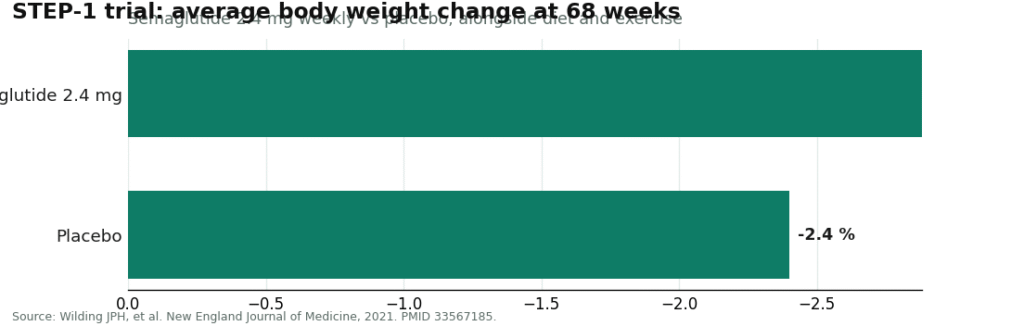
One fact anchors this whole thing, so let’s say it once more plainly: semaglutide, sold as Wegovy and Ozempic, is FDA-cleared, and its weight-loss effect was measured in controlled trials, not just guessed at by someone with a good marketing budget. What shifts from person to person, site to site, is the route you take to get it. The molecule never changes.
Questions I got asked while writing this (and my answers)
Wait, is compounded semaglutide even still legal in 2026? Yes, just on a much narrower basis than before. Once the FDA called the shortage over in February 2025, “there’s a shortage” stopped being a legitimate reason to compound it. A state-licensed pharmacy can still compound semaglutide for one specific patient when a prescriber documents that this individual has a need the FDA-approved product can’t meet [4]. If a site is still leaning on “the shortage” as its whole pitch, that’s your warning sign right there.
How do I quickly tell if a telehealth provider is legit? Check three things: did a licensed clinician actually evaluate and screen you, is there a real individualized prescription, and does a state-licensed pharmacy dispense the product. You need all three present. The clinician screening matters most, because the label carries a boxed warning for thyroid C-cell tumors and rules the drug out entirely for anyone with a personal or family history of medullary thyroid carcinoma or MEN 2 [2].
Why is “research use only” semaglutide such a bad idea? That label is the only legal cover those sellers have, and it works only on paper, as long as nobody’s actually supposed to use the stuff. Nobody screened your history, nobody confirmed what’s actually in the vial, and the FDA has warned that unapproved GLP-1 products can contain the wrong ingredient, too much, too little, or none at all [4]. If it’s mislabeled or contaminated, you’re the one who finds out, alone.
What’s the actual risk with those multi-dose vials from sketchy sellers? Getting the dose wrong, badly. In July 2024, the FDA documented patients drawing five to 20 times the intended dose from compounded injectable vials, some ending up hospitalized, mostly from confusing milligrams, milliliters, and units with no guidance to walk them through it [3]. A no-oversight route hands you a vial and a syringe and nobody to explain any of it.
Is brand Wegovy or Ozempic just flat-out safer than compounded? Brand, through a clinician and a licensed pharmacy, is the most regulated option out there, prefilled pens, full FDA review for safety, effectiveness, and quality. Supervised compounded semaglutide is a legitimate route too, when a real clinician and a licensed pharmacy are both in the chain, and it costs a lot less, but it isn’t FDA-approved and isn’t the same product as brand Wegovy [4]. Honestly it usually comes down to cost versus how much regulatory review you personally want backing what you’re injecting.
Okay, real numbers, what am I actually paying? Compounded semaglutide through a supervised telehealth path runs roughly $129 to $349 a month, priced up front. Brand-name Wegovy or Ozempic paying out of pocket runs roughly $349 to $1,349 a month, and insurance coverage for weight management specifically is genuinely hit or miss.
Okay but what IS semaglutide, actually?
It’s a prescription medication that mimics a gut hormone called GLP-1, the one your body naturally releases after you eat. First approved for type 2 diabetes as Ozempic, then later approved at a higher dose for chronic weight management as Wegovy. You cannot legally buy this as a supplement or grab it over the counter, no matter what some website’s landing page tries to tell you.
Does it actually work, or is this hype?
The evidence is solid, not hype. In the trials behind Wegovy’s approval, adults on the 2.4 mg weekly dose lost significantly more weight than people on placebo, typically landing around 15 percent of body weight over about 68 weeks, alongside a reduced-calorie diet and exercise. Results vary person to person, and weight tends to come back if you stop the medication without other lifestyle changes in place.
Is it safe for me to use?
For most people who meet the approved criteria, yes, it has a pretty well-mapped safety profile built from large trials plus years of real-world data since. Side effects are mostly gastrointestinal, nausea, vomiting, constipation, and they typically ease up as your body adjusts. It’s not appropriate if you have a personal or family history of certain thyroid cancers, and it requires an actual prescriber reviewing your full medical history before you start, not a form you click through.
So where do I actually get this legally, with real oversight, in 2026?
Your two real options: an in-person or telehealth physician prescribing branded Wegovy or Ozempic through a licensed pharmacy, or a physician-supervised compounding pharmacy, like FormBlends, operating under FDA and state board oversight. What you want to steer clear of is anything selling unlabeled “research-grade” peptides or supplement-adjacent products designed to dodge prescription requirements. Those carry real contamination and dosing risks, and if something goes wrong, there’s nobody standing behind it.
References
- Wilding JPH, et al. Once-Weekly Semaglutide in Adults with Overweight or Obesity. New England Journal of Medicine, 2021. PMID 33567185. Mean weight change -14.9% with semaglutide 2.4 mg vs -2.4% with placebo at 68 weeks. https://pubmed.ncbi.nlm.nih.gov/33567185/
- Wegovy (semaglutide) FDA-approved label: boxed warning for thyroid C-cell tumors; contraindicated with personal or family history of medullary thyroid carcinoma or MEN 2. Novo Nordisk, DailyMed (FDA label). https://dailymed.nlm.nih.gov/dailymed/drugInfo.cfm?setid=ee06186f-2aa3-4990-a760-757579d8f77b
- FDA alert: dosing errors associated with compounded injectable semaglutide products; reports of overdoses of five to 20 times the intended dose, some requiring hospitalization. U.S. Food and Drug Administration, 2024.
- FDA’s concerns with unapproved GLP-1 drugs used for weight loss, including counterfeits that may contain the wrong ingredient or amount, and the fact that compounded versions are not FDA-approved and not reviewed for safety, effectiveness, or quality. U.S. Food and Drug Administration.