
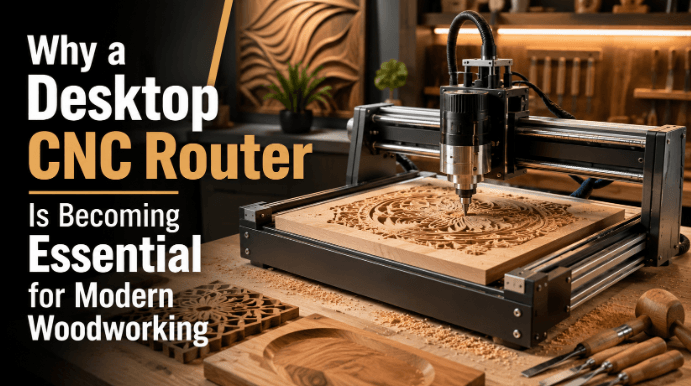
Why a Desktop CNC Router Is Becoming Essential for Modern Woodworking
A New Direction for Woodworking Projects
Woodworking has always depended on skill, patience, and a good understanding of materials. A craftsperson needs to know how wood behaves, how tools cut, and how design choices affect the final piece. For many years, this process was mostly manual. Hand tools and traditional power tools shaped the workshop experience, and they still have an important place today.
However, modern woodworking is changing. More hobbyists, small workshop owners, designers, and makers are now using digital machines to improve accuracy and expand creative possibilities. One of the most useful tools in this shift is the desktop CNC router.
A CNC router allows users to cut, carve, drill, and shape material through computer-controlled movement. Instead of relying only on hand guidance, the machine follows a digital design. This makes it possible to create detailed patterns, repeat accurate cuts, and produce designs that would be difficult to complete manually.
For people who want to improve their woodworking projects, a desktop CNC machine can become a practical and creative partner.
What Makes CNC Routing Different
A CNC router works by using a rotating cutting tool to remove material from a surface. The design is first created or prepared on a computer. Then the machine follows programmed tool paths to cut or carve the material.
This process gives woodworkers a strong advantage. It combines digital design with physical craftsmanship. The machine handles controlled movement, while the maker still decides the idea, layout, material, finish, and final quality.
A machine such as the TTC-450 Pro is designed for users who want a CNC router that supports desktop CNC work, woodworking, and detailed DIY projects. It can be especially useful for makers who need more precision than basic hand tools can provide.
The main difference between CNC routing and traditional cutting is repeatable control. Once a design is prepared correctly, the CNC router can follow it again and again. This is valuable for signs, panels, decorative pieces, furniture parts, and small product batches.
Precision Matters in Woodworking
Wood is a natural material, so it can be unpredictable. Grain direction, density, moisture, and surface quality all affect the result. This is why precision is so important. Even a small measurement error can create gaps, uneven joints, or poor alignment.
A desktop CNC router helps reduce some of these problems by following exact digital instructions. It can cut repeated shapes with consistent spacing and depth. This does not remove the need for skill, but it does give the user a better foundation for accurate work.
For example, if a woodworker needs to create several identical parts for a cabinet, shelf, display, or decorative frame, hand cutting every part can take a lot of time. A CNC router can produce those parts with greater consistency once the file and setup are correct.
Precision is also useful for decorative work. Lettering, patterns, borders, and relief designs need clean movement and steady depth. A CNC router can carve these details in a controlled way, helping the final piece look more polished and professional.
Read also: The Evolution of Wearable Technology: From Fitness Trackers to Smartwatches
Better Creative Freedom for Makers
One of the biggest reasons woodworkers explore CNC technology is creative freedom. A desktop CNC router makes it possible to move beyond basic straight cuts and simple shapes. Makers can design curved patterns, layered textures, engraved lettering, 3D relief carving, and detailed decorative surfaces.
This is especially helpful for custom projects. A client may want a personalized sign, a family name plaque, a business logo, or a decorative wall panel. With CNC routing, the maker can design the piece digitally, preview the layout, and then carve it into the material.
Creative flexibility also helps hobbyists. Many people enjoy woodworking because it allows them to make something personal. A CNC router adds another level of possibility. It allows users to create projects that feel unique while still maintaining clean structure and accuracy.
Some common CNC woodworking projects include:
- Custom wooden signs
- Decorative wall panels
- Nameplates and logo boards
- Relief carving designs
- Small furniture parts
- Cabinet details
- Wooden trays and boxes
- Templates and jigs
These projects can be simple or advanced, depending on the user’s experience. Beginners can start with basic engraving and shallow carving, while advanced users can create complex layered designs.
A Practical Tool for Small Workshops
Not every maker has room for large industrial equipment. This is why desktop CNC machines are so useful. They allow users to bring digital cutting and carving into smaller spaces such as garages, spare rooms, studios, classrooms, or compact workshops.
A desktop CNC router can support many woodworking tasks without requiring a factory-sized setup. This makes it practical for small business owners and independent creators who want to produce custom items without outsourcing every job.
For a small workshop, time and consistency are important. If a maker sells wooden signs, decor items, or custom parts, each order must meet a reliable standard. A CNC router can help maintain that standard by repeating designs accurately.
It also helps with workflow. Once a design is tested and saved, it can be reused or adjusted for future projects. This allows makers to create product variations without starting from zero every time. A name, size, pattern, or layout can be changed while the basic design remains organized.
How Beginners Can Start With CNC Routing
Starting with CNC routing may feel intimidating, but beginners do not need to master everything at once. The best approach is to begin with simple projects and build confidence gradually.
A beginner should first learn the basic parts of the process: design preparation, material setup, tool selection, cutting depth, and machine safety. Each step matters. A good design file will not produce a good result if the material is loose or the wrong cutting bit is used.
Simple beginner projects might include a small engraved sign, a basic cutout shape, a nameplate, or a shallow pattern on scrap wood. These projects help users understand how the machine moves and how wood reacts to different settings.
It is also important to test before working on expensive material. Scrap wood is useful because it gives beginners room to make mistakes. A small error in depth, speed, or alignment can teach an important lesson without ruining a valuable board.
Patience is part of the process. CNC routing rewards careful setup. The more attention a user gives to preparation, the better the final result usually becomes.
The Role of Software in CNC Work
A desktop CNC machine is not only a hardware tool. Software plays a major role in the process. The user needs to create or import a design, prepare tool paths, and send instructions to the machine.
This digital step is where many beginners need practice. A design that looks good on screen must be prepared properly for cutting. The machine needs to know where to move, how deep to cut, what tool to use, and how fast to travel.
Once users become comfortable with software, they gain more control over their projects. They can adjust dimensions, test layout ideas, create repeated patterns, and save files for future use. This makes CNC routing more flexible than many traditional methods.
Software also encourages better planning. Before cutting the material, the maker can think through the design carefully. This reduces waste and helps avoid mistakes.
Why CNC Does Not Replace Craftsmanship
Some people worry that using a CNC router removes the handmade value from woodworking. In reality, CNC is simply another tool. It does not choose the wood, create the idea, sand the edges, apply the finish, or judge the final quality. Those decisions still belong to the maker.
Craftsmanship is not only about cutting by hand. It is also about design judgment, material selection, finishing skill, and attention to detail. A CNC router can improve accuracy, but the final piece still depends on the person using it.
A poorly planned CNC project can still look weak. A well-planned project, finished with care, can look beautiful and professional. The machine provides control, but the maker provides taste and purpose.
This is why many modern woodworkers combine traditional skills with digital tools. They may use CNC for carving and cutting, then use hand sanding, staining, assembly, and finishing techniques to complete the work. The result can be both precise and personal.
Choosing Projects That Match the Machine
A desktop CNC router is powerful, but it should be used thoughtfully. Not every project is a good first project, and not every material behaves the same way. Beginners should choose projects that match their machine size, tool options, and skill level.
Wood selection matters. Softer woods may be easier to carve, while harder woods may require slower cutting and sharper tools. Plywood, MDF, hardwood, and softwood can all produce different results. Testing helps users understand these differences.
Project size also matters. A desktop CNC has a limited working area, so users should plan designs that fit within the machine’s capacity. Larger projects may need to be divided into sections or designed differently.
The best projects are those that balance creativity with practical setup. A maker should choose work that is challenging enough to improve skill but not so complex that it becomes frustrating.
Building Better Results Over Time
CNC routing is a skill that improves with practice. The first few projects may not be perfect, and that is normal. Each attempt teaches something useful. Over time, users learn how to choose better bits, secure material properly, set cleaner cutting depths, and finish pieces more professionally.
A desktop CNC router can become a long-term workshop investment because it supports growth. Beginners may start with simple signs and patterns, then move into furniture details, product templates, layered carvings, and more advanced woodworking projects.
The real value of CNC is not only speed. It is the ability to turn careful ideas into accurate physical results. When used well, it helps makers save time, reduce mistakes, and create work that looks more refined.
A Smarter Future for Woodworking
Woodworking is not losing its traditional character. It is gaining new possibilities. Desktop CNC tools give modern makers a way to combine digital precision with hands-on craft. This combination is useful for hobbyists, small businesses, educators, and professional creators who want better control over their projects.
A CNC router can help with woodworking, carving, custom signs, decorative panels, and repeatable parts. It can make small workshops more capable and give beginners a clear path into digital fabrication.
The best results come when users treat the machine as a tool, not a shortcut. With careful planning, steady practice, and a good eye for detail, a desktop CNC router can help turn simple boards into thoughtful, accurate, and creative work.